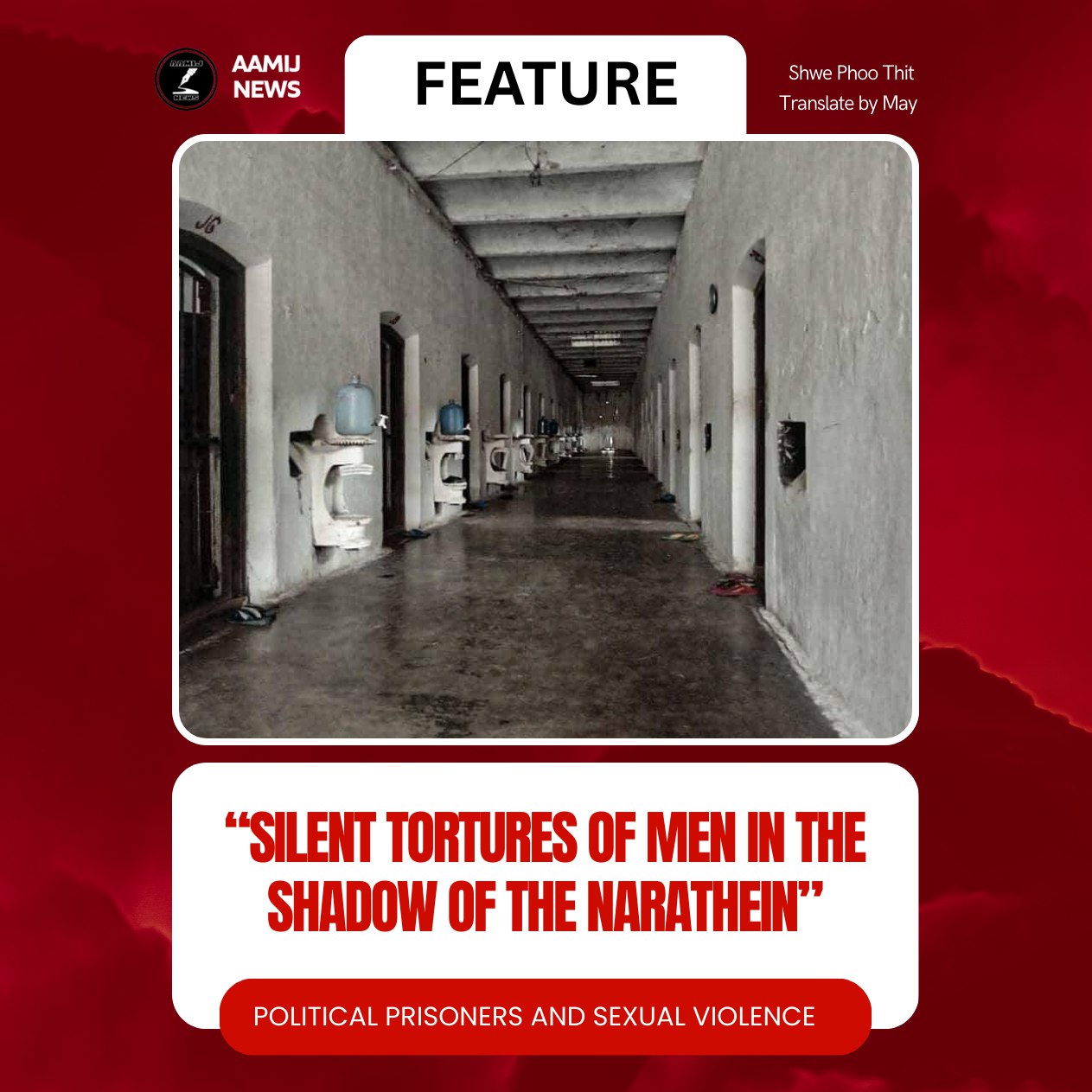
Political Prisoners and Sexual Violence By Shwe Phoo Thit
“I was terrified. Not just ordinary fear. I wasn’t outside; I was inside their interrogation center. At any moment, I could die. At any moment, anything could happen to me. When they tried to do something unbearable, all I could do was scream, ‘Please don’t.’”
These words from Ko Han Thar Nyien, co-founder of Kamayut Media, reveal the trauma of sexual violence he faced during military interrogation—a moment that pushed him to the brink.
Arrested on March 9, 2021, when soldiers raided his office and residence, Ko Han Thar Nyien spent more than four years in detention before his release on April 17 last year. During two harrowing weeks in a Yangon interrogation center, intelligence officers demanded his phone password. When he refused, they escalated to attempted sexual assault.
“One of them squeezed my neck and pinned me against the brick wall while another tried to pull down my pants. At that point, I couldn’t take it anymore—I gave them the password. I knew they weren’t just threatening me; I knew they were actually going to do it,” he recounted.
Since the 2021 coup, Myanmar’s prisons and interrogation centers have become worlds where sexual violence is wielded as a weapon—not only to inflict physical pain but to systematically destroy human dignity.
Threats as Terror
Photojournalist Ko Pho Thar knows this reality well. Arrested twice after the coup, he endured verbal sexual abuse during interrogation. He describes how military intelligence (Sa Ya Pha) officers used objects like vibrators to terrorize detainees.
“They would threaten to insert them into our rectums,” he recalled. “They would say, ‘Answer correctly, or we’ll open a new path for you’—using words too foul to repeat.”
Ko Pho Thar had served two prison terms for political activism before the coup. After the military takeover, he was jailed twice more at Insein Prison. He notes that systematic sexual abuse of political prisoners is a horrific phenomenon he only encountered after 2021.
Prison Lingo: “Child Delivery”
Surviving interrogation offered no safety inside prison walls.
The prison slang “child delivery” refers to sexual assault perpetrated by trustees (inmate-officers) and long-term convicts. Released prisoners say perpetrators are often those serving lengthy sentences or death row convicts whose sentences were commuted to life.
Activist Aung Aung (pseudonym), jailed on political charges, described an assault on his comrade, Tun Tun (pseudonym), an LGBTQ individual, at Thayawady Prison.
“A warder harassed him first. Later, a convict named Pyu Gyi, who was in for rape and murder, tried to rape Tun Tun. When Tun Tun resisted, he was the one sent to solitary confinement and beaten. Pyu Gyi faced no consequences.”
In the prison hierarchy, the system favors murderers and rapists who act as cell leaders over political detainees. Later, at Insein Prison, Tun Tun faced another attempted rape by a notorious contract killer appointed as a room leader. Officials issued only a verbal warning. Tun Tun remains imprisoned, serving a 99-year sentence.
Political Prisoners as Targets
For long-term inmates, the influx of young political detainees created a new pool of victims.
“Before, non-political prisoners were the targets. Now, the victims are mostly young political detainees and LGBTQ individuals,” Aung Aung explained.
Political prisoners were often targeted because of their perceived “refinement.” Many were educated and well-mannered, with no prior experience in the criminal justice system. “They were gentle—and so they became prey.”
Ko Han Thar Nyien added: “Even straight men, if they were handsome or thoughtful, were targeted.” These assaults typically occurred between 1 AM and 3 AM, when the prison was in deep sleep.
Soldiers as Prison Staff
After the coup, the Prison Department was filled with “savages” drawn from military ranks rather than professional civil servants. “They are soldiers,” said Ko Pho Thar. “They know nothing of human rights.”
Under such personnel, degrading treatment became routine—including invasive anal searches after court appearances. Ko Aung Myo Kyaw of the Assistance Association for Political
Prisoners (AAPP) states that this sexual violence is not isolated but a nationwide systemic issue.
In Myanmar, male-on-male sexual assault remains a profound taboo. Survivors are often bound by a silence rooted in traditional notions of masculine honor. This silence emboldens perpetrators and blocks the path to justice.
Voices for Justice
“These abuses aren’t about lust,” Ko Aung Myo Kyaw argued. “They are a systematic tactic to strip dignity—to break a person completely.”
Survivors are now demanding accountability. “When this is over, I want justice—for myself and for my comrades,” said Ko Pho Thar.
Ko Han Thar Nyien believes only systemic change can end the nightmare. “Speaking out alone won’t stop this; only ending the military dictatorship will.”
AAPP emphasizes that documentation is the foundation of future justice. “Because we failed to document properly in the past, we couldn’t hold perpetrators accountable,” said Ko Aung Myo Kyaw. “Survivors shouldn’t remain silent. Only by speaking out can perpetrators face consequences.”
International Recognition
In 2025, the UN Independent Investigative Mechanism for Myanmar (IIMM) classified sexual violence against men in detention as crimes against humanity. Digital evidence from Myanmar Witness in 2026 confirmed systematic torture targeting the genitals of detainees.
According to AAPP, from February 1, 2021, to February 18, 2026, the junta arrested 30,485 people. Of these, 22,789 remain detained, with 11,542 serving sentences.
Inside Myanmar’s prisons, the silent screams of prisoners like Tun Tun continue to echo. Documenting these experiences is the first step toward breaking the cycle of impunity.
Editor: Thway Thit Nay
Photos: Nan Za
Translate by May