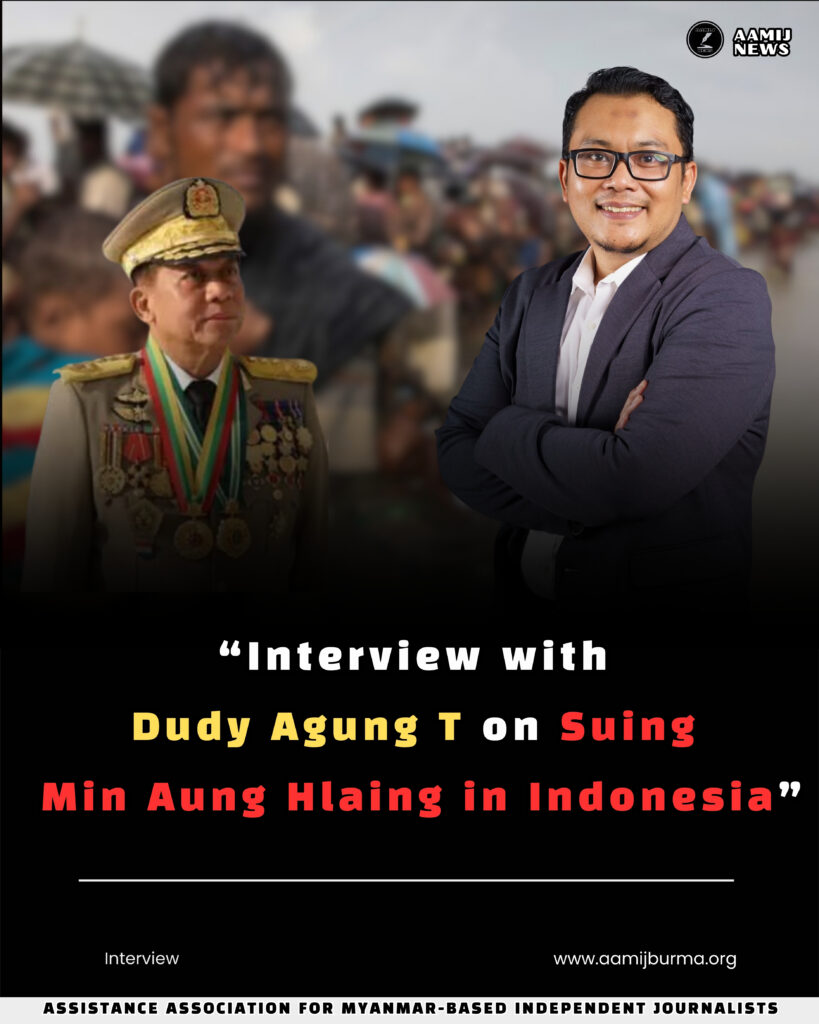
On April 6, 2026, a group led by Rohingya survivor Yasmin Ullah and former Indonesian Attorney General Marzuki Darusman will file a criminal complaint in Jakarta against Min Aung Hlaing and specific Light Infantry Divisions (LIDs).How will this impact justice within ASEAN? Read our exclusive interview with Dudy Agung T, Advocate at Themis Indonesia, as he explains the significance of this legal battle.
AAMIJ: This complaint specifically names Min Aung Hlaing and specific LIDs. How does this local filing in Jakarta complement or differ from the ongoing international cases at the ICJ or ICC?
Dudy Agung T: In principle, every perpetrator of crimes—especially crimes against humanity and genocide—must be held accountable for causing immense suffering to humankind. The complaint filed in Indonesia shares the same objective as those brought before the ICJ and the ICC. We hope that the principle of universal jurisdiction, as incorporated in Indonesia’s new Criminal Code, can encourage the Office of the Attorney General of the Republic of Indonesia to promptly initiate an investigation into the crimes committed by the Myanmar military junta.
AAMIJ: Having figures like former Attorney General Marzuki Darusman and Muhammadiyah leadership involved adds immense weight. How do you plan to use this influence to push the Indonesian government to take a firmer stand on Myanmar?
Dudy Agung T : Marzuki Darusman, as a former Attorney General and former Chair of the United Nations Independent International Fact-Finding Mission on Myanmar in 2017, along with Busyro Muqoddas, a human rights activist and leader within Muhammadiyah, are in a strong position to provide further impetus to the Attorney General’s Office.
AAMIJ: What specific legal actions are you seeking from the Indonesian Prosecutor’s Office? If the complaint is accepted, what is the next step and what is your message to other ASEAN nations regarding universal jurisdiction?
Dudy Agung T: The step we expect is for all ASEAN countries to apply the principle of universal jurisdiction to perpetrators of such crimes so that they may be promptly designated as suspects. In doing so, the movement of these perpetrators would be significantly restricted, preventing them from traveling freely within ASEAN countries. Should they attempt to do so, the visiting state would be in a position to immediately apprehend them.
AAMIJ: The complaint traces “command and control responsibility” to the top leadership. Can you share any specific evidence or insights that establish this direct link between ground atrocities and the dictator?
Dudy Agung T: With regard to the evidence, we would like to emphasize that such evidence is already contained within our complaint and can only be disclosed once the complaint has been formally accepted by the prosecution authorities. Finally, the causal relationship in the crimes against humanity occurring in Myanmar can be understood by considering the extent of power held by the highest leadership, whose governance and political conduct are deeply characterized by militaristic dominance.